

During a placement-preparation session, I asked a group of management students a simple question:
“Why should a recruiter remember you after meeting twenty candidates today?”
One mentioned his degree. Another listed certifications. A third said she was hardworking and passionate. Every answer was respectable—and almost every answer sounded the same.
I see a similar pattern among professionals and faculty members. Their profiles may contain qualifications, publications, FDPs, projects, achievements and institutional responsibilities.
Yet when asked, “What are you distinctly known for?” they often offer a list of activities rather than a clear professional identity.
This is the identity confusion of our time.
Many people are qualified, visible and active online. Very few communicate a professional story that others can understand, trust and remember.
From the boardroom, I learned that strong brands occupy a clear space in the customer’s mind. From the classroom, I have learned that the same principle applies to careers.
How can students, professionals and faculty members build a personal brand that is not merely visible, but credible and memorable?
Why Visibility Matters Now
Professional discovery has become digital-first. Before an interview, meeting, conference invitation, or collaboration, people may search your name, scan your LinkedIn profile, and review your work.
Meanwhile, the value of a degree is being reshaped by changing skill requirements. The World Economic Forum’s Future of Jobs Report 2025 says employers expect 39% of workers’ core skills to change by 2030. LinkedIn’s Future of Recruiting 2025 report finds that 93% of talent acquisition professionals consider accurate skills assessment crucial to improving the quality of hire.
Degrees remain important, but evidence of capability is becoming equally important.
For students, visibility can lead to internships, placements, projects and mentoring. For professionals, it can support career transitions and industry credibility. For faculty members, it can generate research collaborations, guest sessions, consulting assignments, FDPs, conferences and institutional responsibilities.
When students and faculty consistently share useful ideas and credible work, their visibility also strengthens the institution they represent.
The Credibility Problem
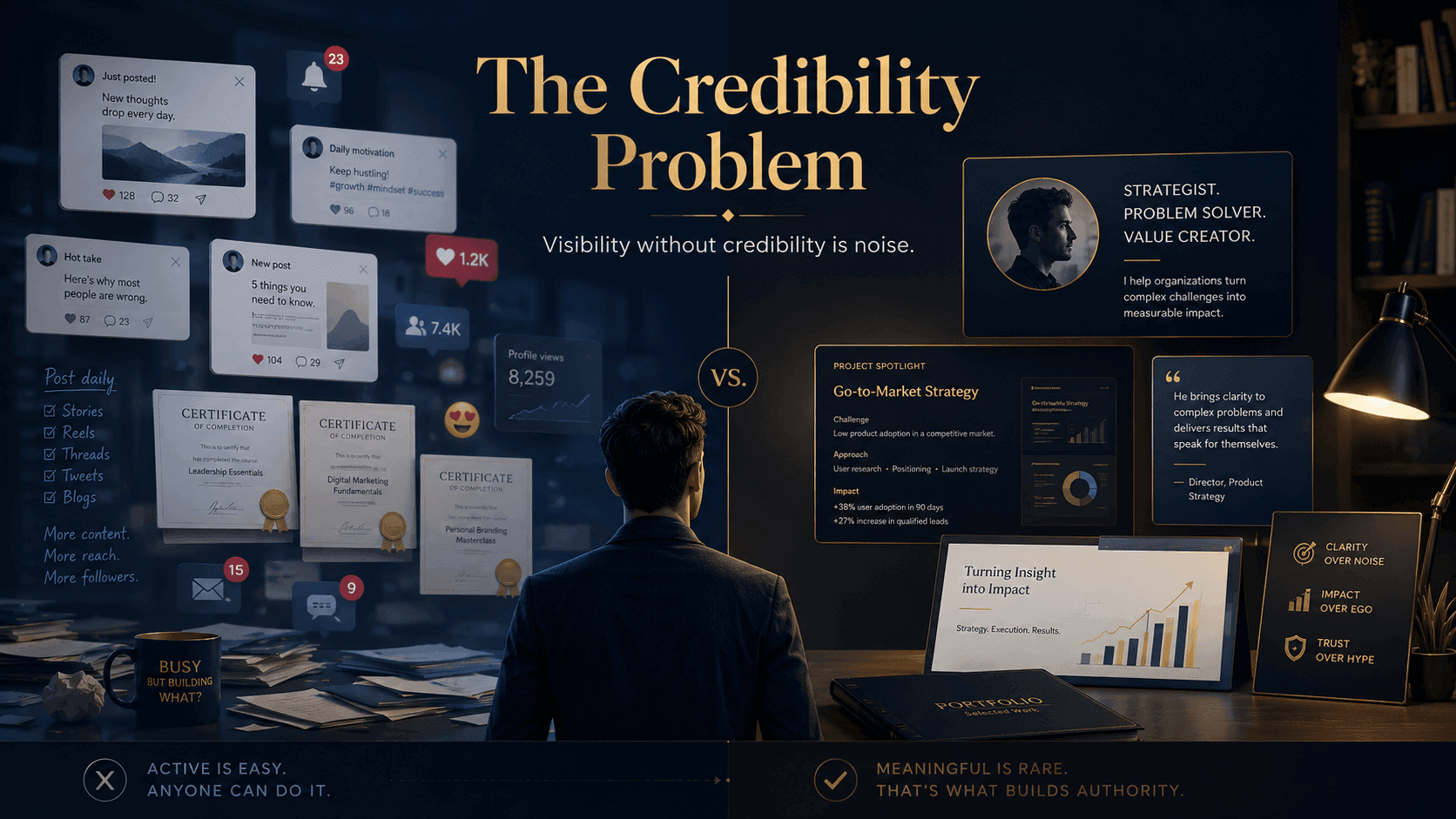
Personal branding is often mistaken for frequent posting, follower counts, or repeated announcements of achievements.
But activity is not authority.
A person may post every day without adding insight. Another may display several certificates without showing what was learned. A student may call themselves a “future business leader” without presenting a project, experience, or idea that supports the claim.
Visibility without credibility is noise.
A credible personal brand does not ask people to believe a claim. It gives them reasons to believe it.
Research has also linked personal branding positively with perceived employability, particularly when it reflects proactive career development and a clearer professional identity.
The goal is not to become louder. It is to become clearer, more useful and more trustworthy.
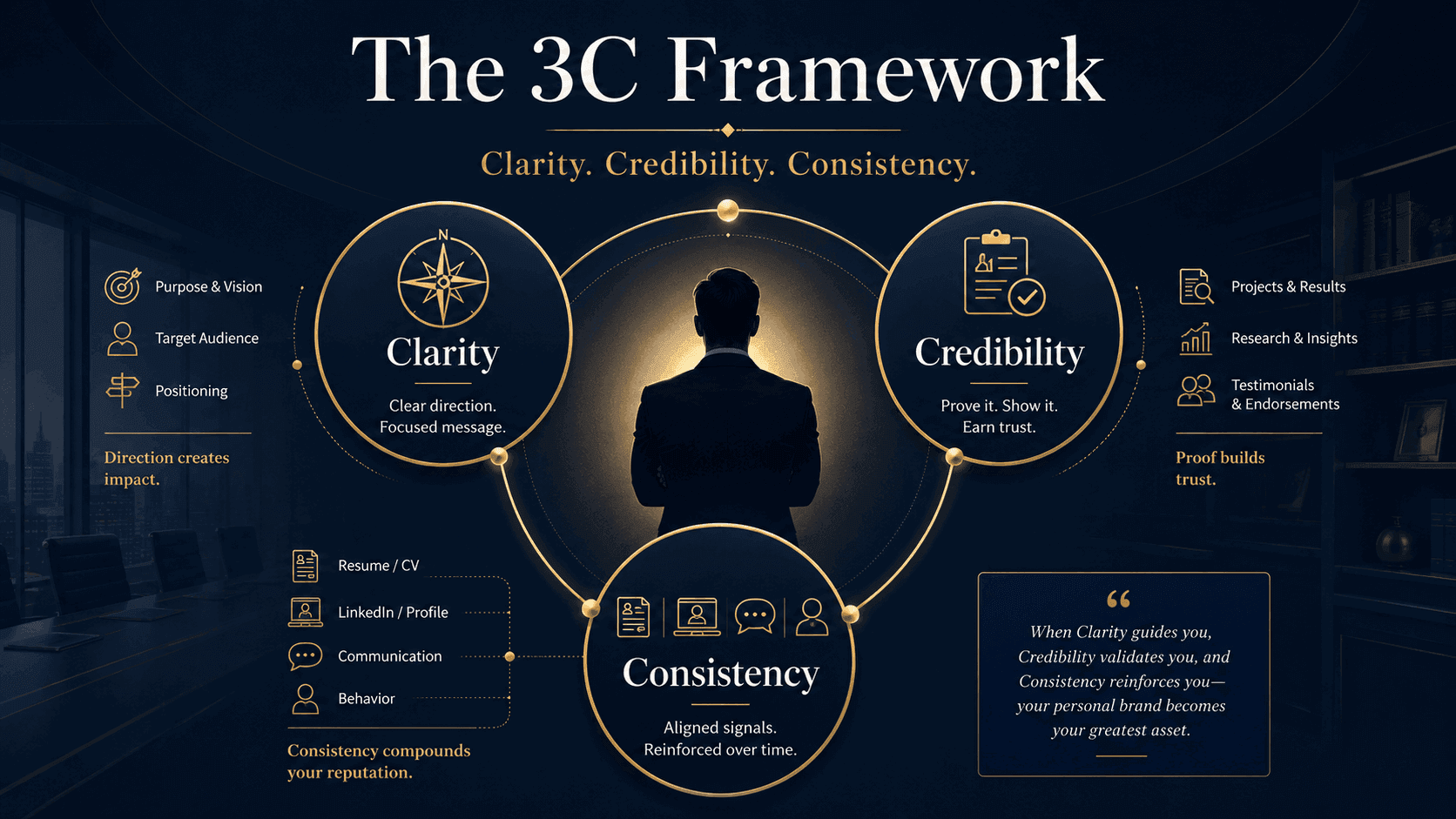
The 3C Framework for a Memorable Personal Brand
1. Clarity: What Do You Want to Be Known For?
Without clarity, your profile becomes a collection of unrelated qualifications and activities.
Ask yourself:
What problems genuinely interest me?
What strengths do others recognise in me?
Which skills am I seriously developing?
What values guide the way I work?
What contribution do I want to make?
A student may choose to become known for financial analysis, consumer insights, social entrepreneurship or data storytelling. A faculty member may focus on outcome-based education, behavioural finance, AI-enabled pedagogy or employability development.
You do not need your entire career mapped out. You need enough direction to make your next choices coherent.
2. Credibility: What Proof Supports Your Identity?
A positioning statement creates interest. Evidence creates trust.
Proof may include internships, live projects, research, assignments, case analyses, presentations, publications, certifications, competitions, mentoring outcomes, institutional work or testimonials.
“I am interested in marketing analytics” is a claim.
“I analysed customer churn data, built a dashboard and presented three retention recommendations” is proof.
Similarly, faculty members can demonstrate expertise through teaching cases, redesigned assessments, classroom experiments, publications, learner feedback and documented outcomes.
Your work should leave visible evidence.
3. Consistency: Do All Your Signals Tell the Same Story?
Personal branding is built through repeated signals.
Your resume, LinkedIn profile, interviews, classroom participation, presentations, writing and professional behaviour should reinforce the same broad identity.
Consistency does not mean publishing identical content. It means avoiding contradiction.
Someone who claims expertise but never shares useful insight creates doubt. Someone who promotes professionalism but communicates carelessly weakens trust.
People remember patterns, not isolated posts.
Five Actions Students Can Take Immediately
- Write a one-line positioning statement
Try this structure:
“I am a [course or role] interested in [domain], developing [capability] to contribute to [problem or outcome].”
- Improve your LinkedIn headline and About section
Go beyond “Student at…” Add your domain interests, emerging skills and professional direction.
- Turn experience into evidence
For each internship or project, explain the problem, your contribution, the tools used and the outcome or learning.
- Share one thoughtful post each week
Reflect on a classroom concept, project, business observation, book or industry development. Add interpretation rather than merely reposting.
- Build a proof portfolio
Organise your best presentations, dashboards, caselets, writing samples, research summaries and applied certifications in one digital space.
Five Actions Faculty Members Can Take
- Define two or three expertise areas
Your designation explains your role. Focused themes communicate your intellectual identity.
- Share teaching and research insights
Write about classroom observations, emerging practices, conceptual challenges or pedagogical experiments.
- Convert classroom experience into scholarship
Student questions can become articles. Teaching innovations can become cases. Institutional challenges can generate frameworks or research ideas.
- Build visibility through contribution
Share what others can learn from your work—not only where you were invited or which certificate you received.
- Make academic impact visible
Document publications, FDPs, talks, mentoring, curriculum design, accreditation work, institutional initiatives and student outcomes.
What Does Your Name Communicate?
Pause and ask yourself:
If someone searches your name today, what professional story will they find—and what will they remember after closing the screen?
A degree or designation establishes context.
Your contribution establishes identity.
Degrees Create Access. Brands Create Recall.
A degree can help you enter the conversation. It signals that you have completed a recognised journey of learning.
But opportunities increasingly move towards people whose capabilities are clear, whose work is visible and whose contribution is trusted.
Personal branding is not self-promotion. It is the disciplined process of building clarity, credibility and contribution over time. It is the alignment between what you want to be known for, what you can prove and how consistently you demonstrate it.
Your professional brand is not created by one viral post or one impressive achievement. It is created through a pattern of meaningful work.
The question is no longer only:
“What qualification do you have?”
The more powerful question is:
“What do people associate with your name?”