
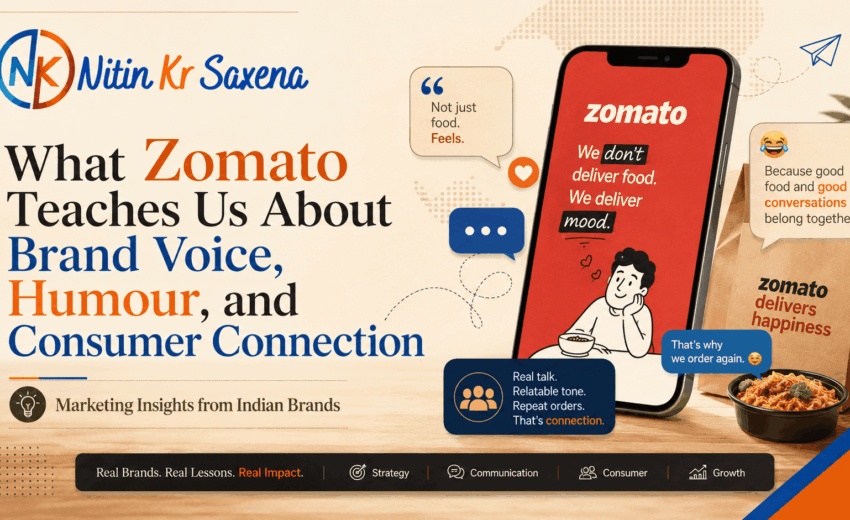
During a classroom discussion on digital branding, a student’s phone lit up with a Zomato notification.
It was not a conventional promotional message announcing a discount or free delivery. It was a witty reminder about hunger, unfinished assignments, and the difficulty of deciding what to eat.
The class laughed.
A few students immediately checked their phones. One opened the Zomato app. Another began recalling similarly humorous notifications received earlier.
That brief interruption became more useful than the slide on the screen.
It demonstrated an important branding lesson: consumers may forget an advertisement, but they often remember how a brand made them feel.
Zomato has built much of its consumer connection around this understanding. Its digital branding does not always sound like a company speaking to customers. It frequently sounds like a culturally aware friend who understands hunger, work pressure, relationships, cricket, festivals, late-night cravings, and everyday Indian life.
The Central Question
What can management students and young marketers learn from Zomato’s ability to use brand voice, humour, and cultural relevance to build consumer connection in a highly competitive Indian market?
The Indian Food-Delivery Market: When Functional Benefits Become Similar
Online food delivery is a category in which competing platforms offer broadly comparable functional benefits: restaurant discovery, convenience, discounts, digital payments, order tracking, and doorstep delivery.
When product features become easier to imitate, brands require another source of differentiation.
That difference may come from user experience, reliability, ecosystem strength, or brand personality.
Zomato currently reports more than 25 million monthly customers, over 300,000 restaurant partners, and a network of more than 500,000 delivery partners. These numbers show that its communication operates at the scale of a mass-market Indian brand, not merely a niche digital start-up.
The company behind Zomato changed its corporate name to Eternal in 2025 as its portfolio expanded beyond food delivery. However, Zomato remained the customer-facing food-delivery brand—an indication of the consumer equity accumulated under its name.
In such a market, the challenge is no longer simply to tell consumers, “We deliver food.”
The challenge is to remain mentally available when hunger, convenience, boredom, celebration, or an unexpected craving creates an occasion to order.
The Consumer Tension: Convenience Without Communication Clutter
Zomato responds to a tension that defines contemporary consumer behavior:
Consumers want convenient digital services, but they do not want every brand interaction to feel like another advertisement.
Young consumers receive promotional emails, app notifications, social media advertisements, influencer recommendations, reels, offers, and discount codes throughout the day.
Most of these messages are ignored because they demand attention without offering anything emotionally interesting in return.
Digital audiences want useful information, but they also expect entertainment, recognition, and relevance. They are more receptive when a brand understands their mood instead of merely pushing a transaction.
Zomato recognised that food ordering is not always a rational decision. It can be triggered by fatigue, loneliness, celebration, social influence, weather, work pressure, convenience, or the simple unwillingness to cook.
Its communication therefore speaks to the occasion surrounding the order, not only to the food being ordered.
The Strategic Brand Decision: Turning Voice into a Brand Asset
Zomato’s key strategic decision was to treat brand voice as more than advertising copy.
Its voice became part of the customer experience across:
- Social media conversations
- Push notifications
- Outdoor advertising
- App communication
- Packaging and delivery touchpoints
- Topical and moment-based marketing
The tone is usually conversational, observant, playful, self-aware, and culturally current.
The strategic principle is not, “Every message must contain a joke.”
It is:
Every message should sound recognizably like Zomato.
That distinction matters. Humour may attract attention, but a consistent voice builds identity.
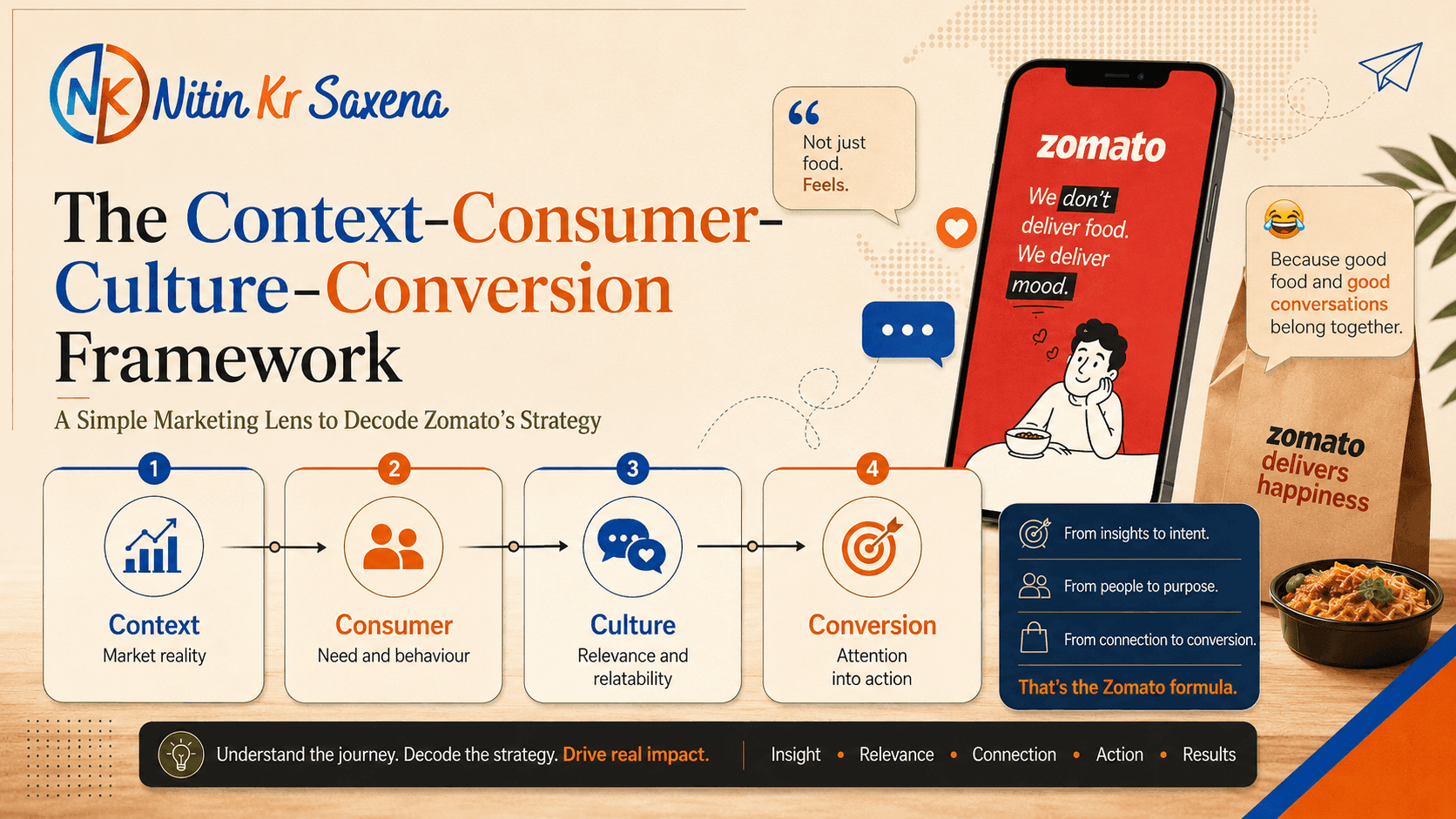
The Context–Consumer–Culture–Conversion Framework
Zomato’s Indian brand strategy can be examined through four connected questions.
Context
What is happening in the market, category, competition, or media environment?
Consumer
What does the brand understand about consumer needs, habits, emotions, anxieties, and decision-making behavior?
Culture
How does the brand connect with language, humour, festivals, entertainment, social conversations, and everyday Indian life?
Conversion
How does the brand translate attention into app visits, orders, recall, trust, repeat behavior, or advocacy?
This framework helps marketing students move beyond describing a campaign. It encourages them to connect communication with consumer behavior and business outcomes.
Decoding Zomato’s Brand Strategy
Context: Competing in an Attention-Saturated Category
Food-delivery platforms compete not only for market share but also for mental availability.
Consumers may have more than one delivery app installed. Their final choice can depend on price, restaurant availability, delivery time, prior experience, or whichever brand first enters their mind.
Zomato uses distinctive communication to remain visible between ordering occasions.
Its humour gives the brand a role even when consumers are not actively purchasing. A social post, billboard, or notification becomes a reminder that the brand understands the situations in which hunger appears.
Consumer: Understanding the Emotion Behind the Order
Zomato does not treat hunger as a single functional need.
It recognizes different consumption moments:
- The student ordering during an examination week
- The employee finishing a late meeting
- The family planning a weekend meal
- The cricket fan ordering during a match
- The young professional looking for comfort food
- The consumer unable to decide what to eat
These are behavioral contexts, not simply demographic segments.
This is an important advertising insight: strong communication often begins with a recognizable human tension rather than a product feature.
Culture: Speaking the Language of Everyday India
Zomato’s humour often draws from Hinglish, films, cricket, relationships, office life, festivals, internet culture, regional food preferences, and familiar social situations.
This makes the brand feel culturally present rather than institutionally distant.
However, cultural participation requires sensitivity. Humour can create connection only when the audience feels included in the joke.
Zomato experienced this risk with its 2023 “Kachra” recycling advertisement. Following criticism that the campaign was culturally and socially insensitive, the company removed the advertisement and apologized. The incident demonstrated that cultural references cannot be separated from their social meaning.
The lesson is not that brands should avoid bold communication. It is that cultural fluency must be accompanied by empathy, contextual understanding, and responsible review.
Conversion: Moving from a Smile to an Order
Humour generates attention. Relevance creates memory. Consistency builds recognition.
But marketing strategy must eventually connect these outcomes with consumer action.
Zomato’s communication frequently links everyday emotions to hunger, food discovery, or ordering occasions. This product bridge is crucial.
A post may be entertaining, but its strategic value increases when it encourages one or more of the following:
- App opening
- Restaurant discovery
- Order consideration
- Brand recall
- Social sharing
- Repeat engagement
- Preference over competing platforms
Not every like becomes an order. However, repeated culturally relevant interactions can strengthen mental availability when a purchase occasion eventually arises.
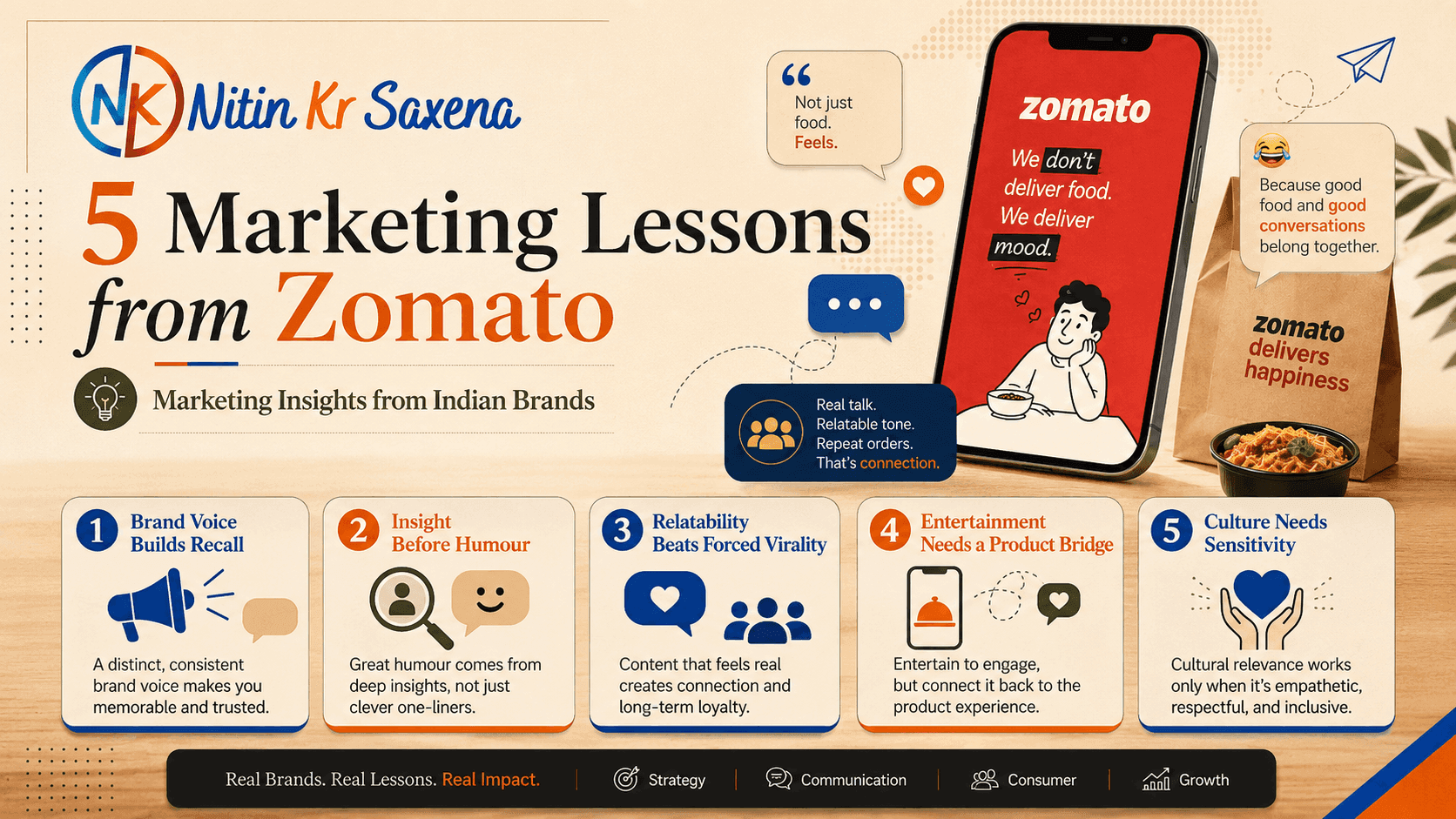
What Marketing Students Can Learn
Marketing students should use Zomato as a live case study rather than merely collecting screenshots of witty advertisements.
They can:
- Study how the brand adapts its voice across notifications, billboards, social media, and the app.
- Identify the consumer tension behind each piece of communication.
- Apply the Context–Consumer–Culture–Conversion Framework to individual campaigns.
- Compare engagement-oriented content with conversion-oriented content.
- Analyse both successful communication and strategic mistakes.
Students should also distinguish between brand voice and brand tone. Voice is the enduring personality of the brand. Tone changes with the situation.
What Young Marketers Can Apply
Young marketers can translate these branding lessons into practical action:
- Define three to five characteristics that describe the brand’s voice.
- Build campaigns around real consumer behavior, not only creative ideas.
- Adapt the execution for each platform without losing brand consistency.
- Measure outcomes beyond likes, including recall, app visits, leads, trials, and purchases.
- Use AI in marketing to study audience patterns, personalize timing, and generate alternatives—but retain human judgment for humour, culture, and ethical sensitivity.
AI may help a team create one hundred headlines. It cannot automatically determine which headline respects cultural context or strengthens long-term brand meaning.
A Question for Reflection
If Zomato disappeared from social media tomorrow, would consumers miss only its offers—or would they also miss the way the brand speaks?
The answer reveals the difference between promotional visibility and genuine brand connection.
Closing Takeaway
Zomato teaches us that humour is not a substitute for strategy.
Its strongest communication works because it connects market context with consumer emotion, translates everyday culture into recognizable language, and creates a bridge from attention to action.
The best Indian brands do not merely sell products or services. They observe how people live, understand what they feel, participate intelligently in culture, and convert relevance into business outcomes.
That is the real branding lesson for management students, marketing students, educators, and young professionals.