
A student once entered a placement interview carrying an impressive résumé—strong marks, several certificates, and a respectable summer internship.
The interviewer began with a simple request:
“Tell me about yourself.”
The student repeated details already written on the résumé. When asked what problem he had solved during his internship, his answer became vague. When asked what differentiated him from other candidates, he paused.
The interview ended within ten minutes.
The student was academically capable. He had attended placement workshops and prepared common interview questions. Yet he was trying to build in a few weeks what should have been developed over several semesters: clarity, confidence, capability, communication, and professional maturity.
This is a pattern I have repeatedly observed while interacting with students, faculty members, placement teams, and industry professionals.
Central Question
Why do capable students with good degrees, respectable marks, and multiple certificates still struggle during internships and placement interviews?
More importantly, how can students begin building employability from the first semester rather than attempting to manufacture it in the final one?
Why This Matters Now
The employment market is changing faster than most curricula.
The World Economic Forum’s Future of Jobs Report 2025 estimates that 39% of the key skills required in the workplace will change by 2030. At the same time, technology-related abilities are growing in importance alongside analytical thinking, resilience, collaboration, leadership, and the ability to learn continuously.
In India, Mercer’s Graduate Skill Index 2025 reported that employers increasingly value critical thinking, communication, and learning agility, while overall graduate employability remains a concern.
The message is clear: a degree remains important, but a degree alone is no longer sufficient evidence of workplace readiness.
Recruiters are not merely asking, “What have you studied?”
They are asking:
What can you do?
How effectively can you communicate?
Can you apply your learning?
Can you work with others?
Can you adapt when the situation changes?
Your final semester is too late to begin answering these questions.
Skill Gap Insight: The Preparation Debt
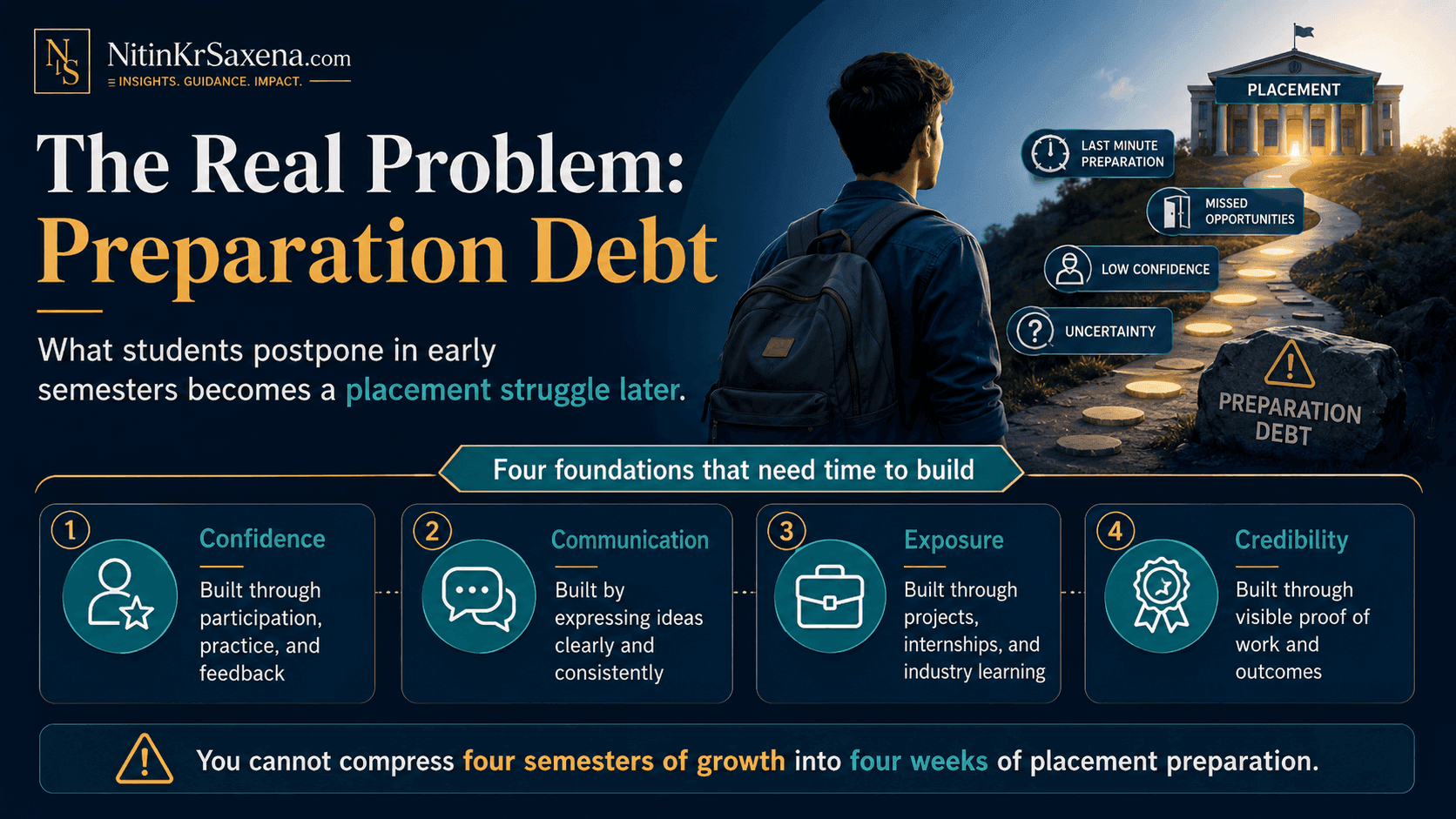
Students often accumulate what I call preparation debt.
Like financial debt, it grows quietly. Each semester spent avoiding presentations, postponing internships, copying assignments, ignoring feedback, or remaining invisible professionally adds to it.
By the final semester, students attempt to repay this debt through résumé workshops, mock interviews, aptitude classes, and hurried LinkedIn updates.
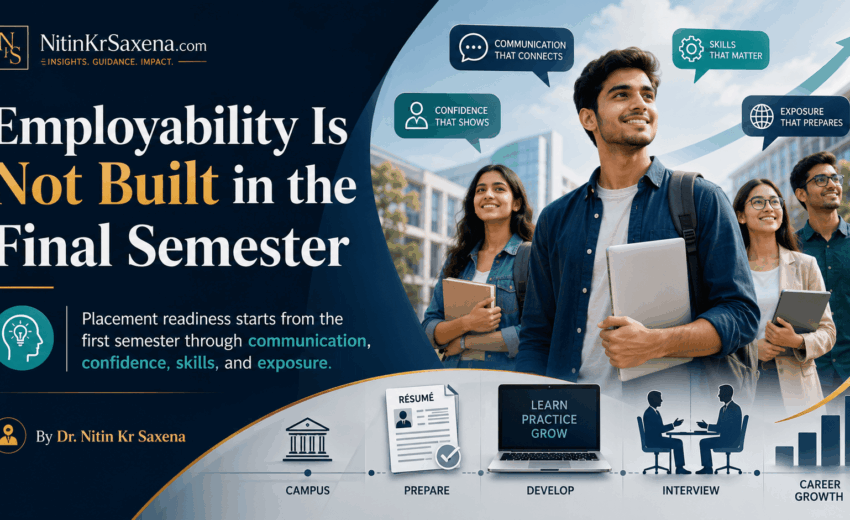
But four elements cannot be compressed into a few weeks.
Confidence needs repetition.
You become confident by speaking, participating, making mistakes, receiving feedback, and trying again.
Communication needs practice.
Knowing an answer and expressing it clearly are different capabilities.
Professional judgment needs exposure.
Classroom concepts become meaningful when students interact with businesses, customers, professionals, projects, internships, cases, and real problems.
Credibility needs evidence.
Claims such as “I am a good leader” or “I have excellent analytical skills” mean little without examples, outcomes, recommendations, projects, or visible work.
Employability is not a final-semester activity; it is a structured developmental journey.
Recruiter Expectation
Recruiters understand that fresh graduates may not have extensive experience. They are not expecting students to arrive as finished managers.
They are looking for indicators of future performance.
A student who listens carefully, structures an answer, accepts feedback, demonstrates curiosity, and explains a project honestly may be preferred over someone with higher marks but little self-awareness.
Recruiters commonly look beyond academic scores for:
- Clear and confident communication
- Evidence of initiative and ownership
- Practical understanding of concepts
- Problem-solving and learning ability
- Professional behaviour and reliability
- Awareness of industry and business realities
- A credible résumé and digital presence
- The maturity to work with different people
In an AI-enabled workplace, knowing how to use tools is valuable. Knowing how to think, question, verify, communicate, and apply those tools responsibly is even more valuable.
Skill–Story–Signal Framework
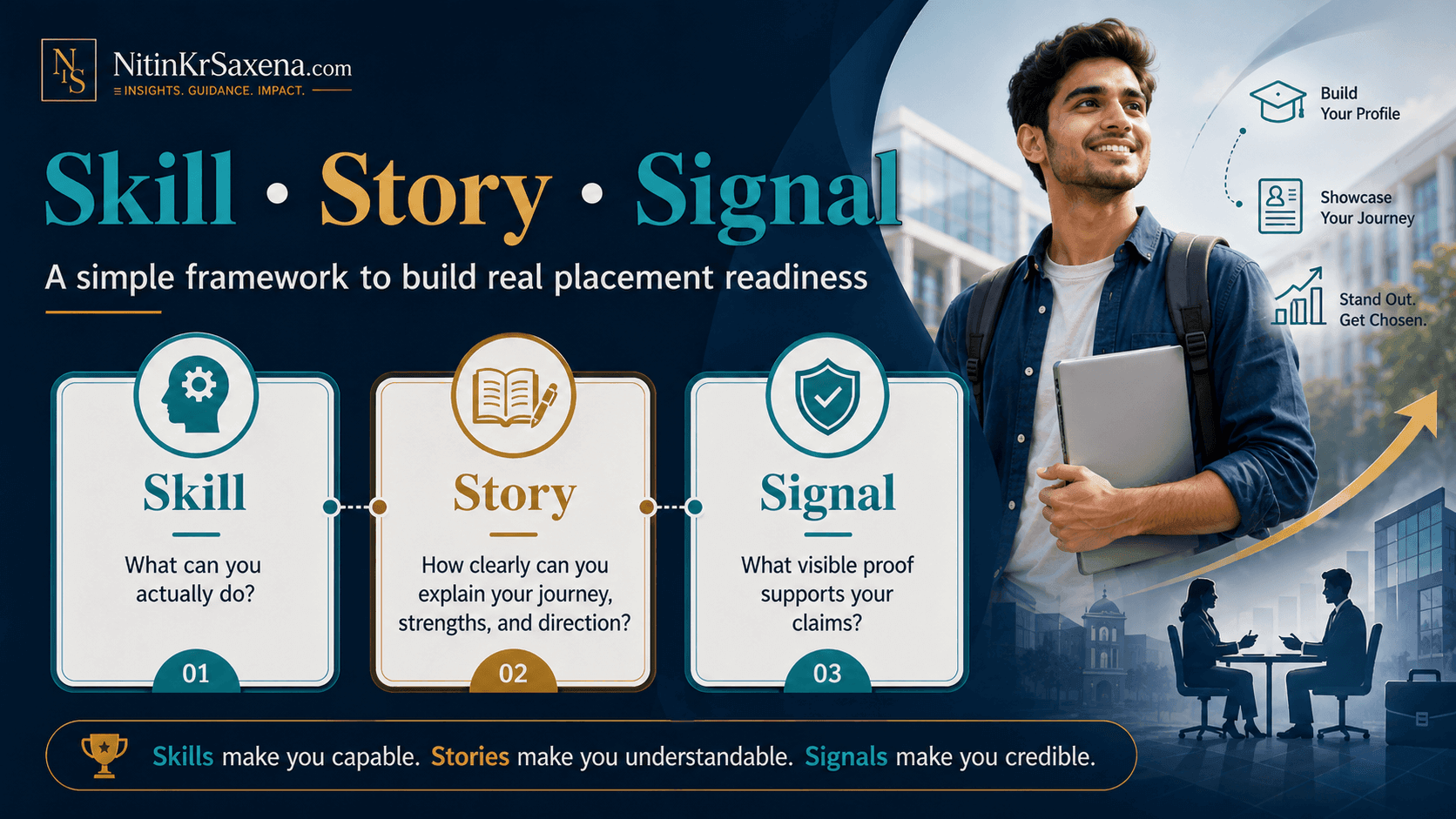
Students can evaluate their readiness through a simple framework: Skill–Story–Signal.
Skill: What can you actually do?
A skill must produce an outcome.
Instead of saying, “I know Excel,” explain that you cleaned sales data, created a dashboard, identified regional trends, and presented recommendations.
Instead of listing digital marketing, demonstrate how you planned a campaign, analysed engagement, or improved content performance.
Story: How clearly can you explain your journey?
Recruiters do not remember disconnected certificates. They remember coherent stories.
Your story should connect your interests, choices, projects, strengths, learning experiences, and career direction. It should explain not only what you did, but what you learned and how you grew.
Signal: What visible proof supports your claims?
Projects, internships, competition results, portfolios, LinkedIn posts, recommendations, case analyses, certifications, presentations, and measurable outcomes are professional signals.
Skills make you capable. Stories make you understandable. Signals make you credible.
5 Actions for Students
1. Write your two-line professional positioning statement
Complete this sentence:
“I am a ______ student interested in ______. I am building capabilities in ______ through ______.”
Use it to bring clarity to your résumé, LinkedIn profile, self-introduction, and learning priorities.
2. Create one proof-of-work project this month
Choose a real problem connected to your field. Analyse a company, build a dashboard, conduct a customer survey, redesign a process, prepare a financial model, or develop a campaign.
Publish the process, insights, and outcome—not merely the certificate.
3. Practice your 60-second introduction every week
Your introduction should cover who you are, what you are learning, one relevant experience, your strengths, and the opportunity you seek.
Record yourself. Review your clarity, pace, posture, filler words, and confidence.
4. Build one meaningful exposure every semester
Complete an internship, live project, industry interaction, competition, volunteering assignment, research project, or professional shadowing experience.
Exposure converts theoretical knowledge into professional understanding.
5. Maintain a career-readiness tracker
Every month, record one skill developed, one project completed, one professional interaction, one piece of feedback received, and one visible signal created.
Small actions accumulated over several semesters create substantial career capital.
Reflective Question
If your placement interview were scheduled tomorrow, what evidence—beyond your marks and degree—would convince the recruiter that you are ready to contribute?
Takeaway
Placement success is rarely created during placement week.
It is built quietly through every presentation attempted, every project completed, every conversation initiated, every piece of feedback accepted, and every experience converted into learning.
Do not wait for the final semester to become employable.
Use every semester to become more capable, more articulate, more visible, and more credible.
Your degree may make you eligible for an opportunity. Your preparation determines whether you are ready for it.
Begin today with the Skill–Story–Signal audit.
Identify one skill you need to strengthen, one professional story you need to articulate, and one visible signal you can create during the next 30 days. Then act on all three—before another semester passes.
Your Degree Opens the Door. What Makes Them...